Building AI Chatbots That Drive Business Value: An MVP Guide
MVP
3 mins
Nov 24, 2025

Khyati Mehra

The term "chatbot" often conjures up basic pop-ups that struggle with questions beyond scripted responses. Previously, these tools were more frustrating than useful.
AI Chatbots as a Strategic Necessity
Modern AI chatbots, powered by Large Language Models (LLMs), have evolved from static scripts into intelligent systems. This shift allows businesses to automate complex processes, offering significant strategic benefits.
Strategic Value in AI MVP Development
For tech ventures, AI chatbots are central to launching a Minimum Viable Product (MVP). They provide a direct path to market validation by:
Accelerating Market Validation: Rapid deployment enables user testing at lower costs and quicker timelines.
High-Fidelity User Insights: Each interaction generates valuable data on user needs and behaviors, crucial for product development and investor interest.
Operational Leverage: Automating tasks like customer support allows teams to focus on growth and product enhancement.
AI chatbots signify technical competence and a scalable strategy, making them attractive to investors as functional, data-driven solutions.
Understanding the Tech Behind AI Chatbots
Building impactful AI products requires understanding their architecture. The transition from basic bots to business tools marks a significant technological shift.
The Role of Large Language Models (LLMs)
LLMs like OpenAI's GPT analyze user input and predict responses. However, relying solely on pre-trained LLMs can lead to inaccuracies due to a lack of specific organizational knowledge.
Enhancing Accuracy with Retrieval-Augmented Generation (RAG)
RAG connects LLMs to proprietary data, ensuring responses are based on verified information, improving accuracy and aligning with company facts.
The Future: Multi-Agent Systems
Next-generation AI involves multi-agent systems, where specialized agents collaborate to solve complex tasks, such as booking business trips. This approach allows for sophisticated automation, crucial for startups aiming for a technological edge.
Key AI Chatbot Architectures
Architecture | Core Function | Best Use Case | Business Implication |
|---|---|---|---|
LLM-Only | Text generation from general data | Creative tasks and simple Q&A | Fast to prototype but risky for business use due to inaccuracies |
RAG | Retrieves specific data before responding | Tasks needing factual accuracy | Builds trust and reduces errors |
Multi-Agent | Coordinates multiple AI agents | Complex workflows | Enables advanced automation for competitive advantage |
Selecting the right architecture influences the MVP's capabilities and market viability.
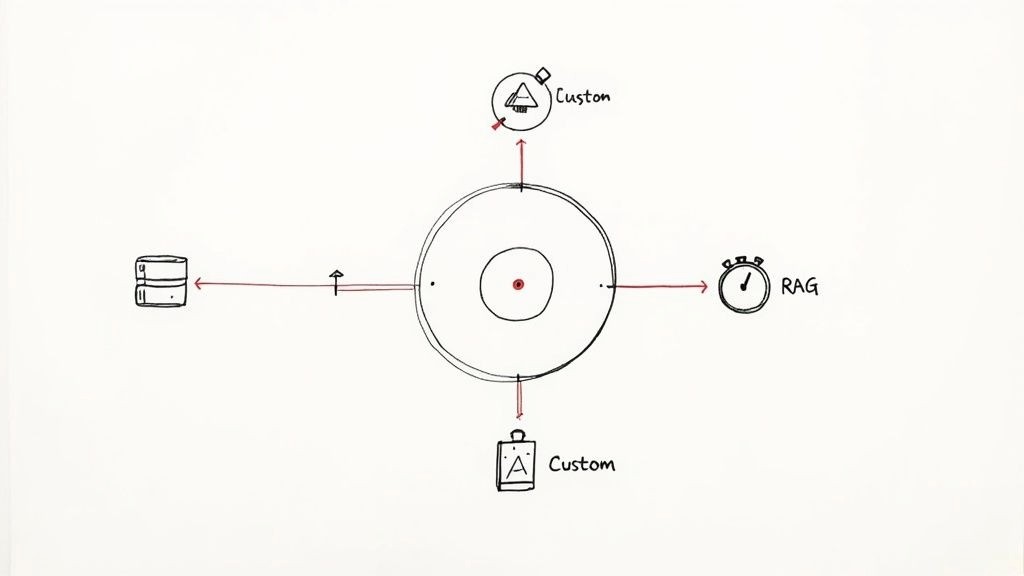
How Industries Use AI Chatbots
AI chatbots solve complex problems across industries like FinTech, SaaS, and healthcare, impacting revenue and customer loyalty.
FinTech: Automating Compliance
AI chatbots automate compliance tasks, reducing manual review times and errors, and providing scalable advisory services.
SaaS: Enhancing Onboarding
SaaS companies use chatbots for dynamic, personalized onboarding, improving user engagement and reducing churn.
Healthcare: Improving Patient Engagement
Chatbots streamline healthcare processes, from scheduling to symptom triage, improving efficiency and patient care.
By 2025, nearly 987 million people will use chatbots, highlighting the need for businesses to execute AI strategies effectively.
Scoping Your AI Chatbot MVP
A well-defined MVP focuses on a single, high-value problem, ensuring efficient market validation and growth potential.
Define One Problem and Solve It Perfectly
Avoid feature creep by solving a specific problem exceptionally well, demonstrating clear value and aiding in fundraising efforts.
Data Strategy for a RAG-Powered MVP
A successful MVP relies on a curated, structured dataset, prioritizing quality over quantity to enhance chatbot accuracy.
Choosing Your Development Pathway
Decide between no-code/low-code platforms for rapid prototyping or custom development for complex applications, based on your objectives and resources.
Designing a Conversational Experience
Effective chatbot design requires a natural, intuitive user experience driven by advanced prompt engineering.
Core Principles of Conversational UX
Clear Persona: Consistent personality aligned with brand voice.
Set Expectations: Clearly communicate bot capabilities and limitations.
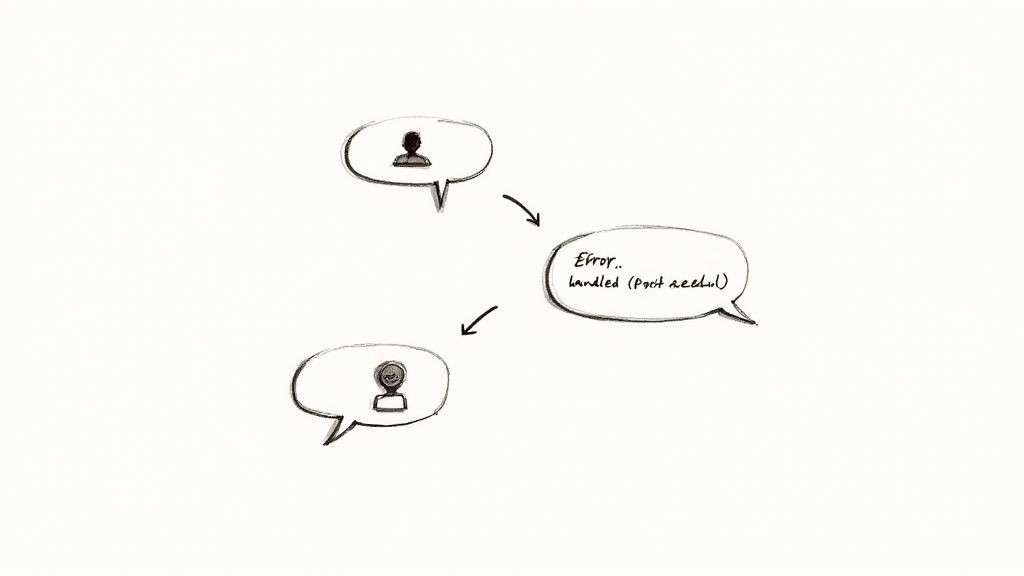
Manage Errors Gracefully: Provide helpful error messages and escalation paths.
Advanced Prompt Engineering
Craft precise instructions to guide the AI's responses, ensuring accuracy and brand alignment.
Measuring Success and Ensuring Readiness
Prove business value through KPIs like task completion rate, containment rate, and user satisfaction, while ensuring security and compliance.
Fortifying Security
Ensure data privacy and robust security protocols to build trust and gain a competitive advantage.
The AI chatbot market is growing, with ChatGPT leading with 81.37% market share. Building a secure, reliable solution is critical for niche differentiation.
Common Questions About AI Chatbots
How Much Data Is Needed?
Focus on quality and relevance over quantity for a RAG architecture.
Biggest Mistake in Building a Chatbot MVP?
Avoid over-scoping; solve a single problem exceptionally well.
Ensuring Accuracy and Safety?
Use RAG for factual grounding, implement safety protocols, and design clear error-handling strategies.
Ready to develop an AI chatbot that delivers real value? Contact us at Magic to turn your ideas into market-ready solutions. Get in touch today.