How to Validate Your Startup Idea: An Analytical Framework
MVP
4 mins
Nov 17, 2025

Khyati Mehra

If you're thinking about launching a startup, especially in the AI space, having a great idea is just the beginning. Before you dive in with your resources and reputation, it's crucial to validate that idea. This isn't just a checklist; it's a structured approach to reducing risk and testing your assumptions about the market, customers, and your solution before you build anything. It’s about gathering concrete evidence to ensure there's a real demand for what you're envisioning.
Why Startups Often Fail and How Validation Can Help
Let's be real: many startups don't make it. According to CB Insights, 38% of failures are due to a lack of market need. Founders often build solutions for problems that aren't pressing enough. This disconnect is a major reason so many ventures don't survive.
Here are some sobering numbers: about 90% of startups eventually fail, with 10% shutting down in the first year and 70% not making it past five years. These aren't just statistics; they’re lessons on the importance of taking a systematic, evidence-based approach to building your business.
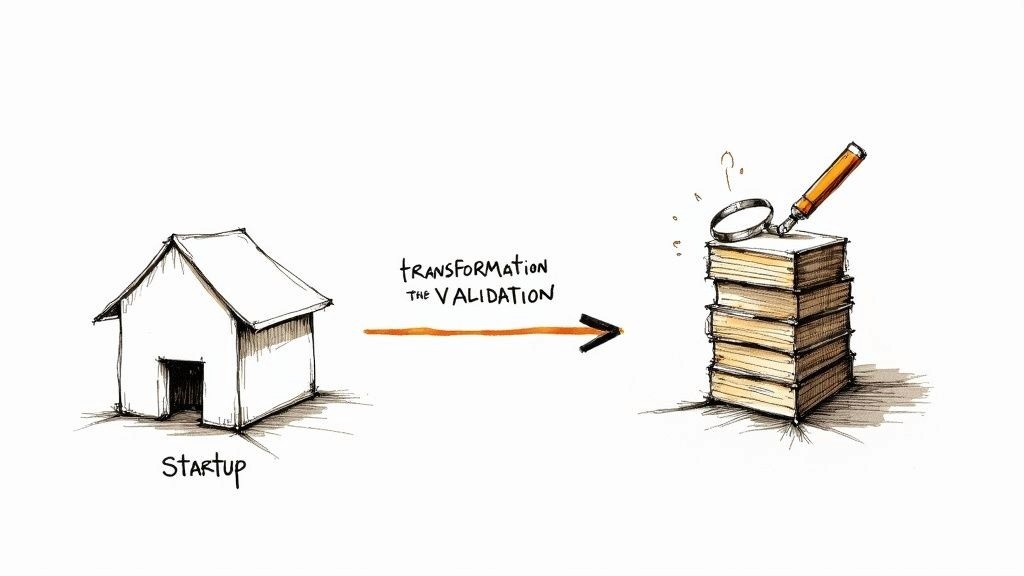
Using Validation as Your Safety Net
Think of idea validation as your primary strategy for minimizing risk. It's a methodical way to break down your business model into assumptions and then find evidence to support or challenge them. This process helps you move from "I think this will work" to "I have the data to back this up."
A strong validation process offers several benefits:
Efficient Use of Capital: You avoid wasting time and money on features or products with no demand.
Investor Trust: Data-driven insights make a more compelling case for investors, proving you've minimized risks.
Faster Product-Market Fit: By addressing a verified problem from the start, you can reach product-market fit more quickly.
Before jumping into specifics, let's outline the process. We suggest a four-phase validation campaign to take you from concept to a market-ready venture.
The Four Phases of Idea Validation
Phase | Primary Objective | Key Activities & Outputs |
|---|---|---|
Phase 1: Define & Hypothesize | Clarify the problem, customer profile, and solution idea. | Problem statements, customer personas, value propositions, and a list of assumptions. |
Phase 2: Discover & Interview | Engage customers to confirm the problem's existence and severity. | Interview scripts, qualitative data, validated hypotheses, refined profiles. |
Phase 3: Experiment & Test | Test demand for your solution with low-cost experiments. | Landing page tests, early sign-ups, prototypes, Letters of Intent. |
Phase 4: Analyze & Decide | Use experimental data to make informed decisions. | Analyze key metrics, decision frameworks, product roadmaps. |
Each phase builds your confidence while keeping costs low. Start by defining your landscape, then narrow your focus based on market feedback.
A Modern Approach to Validation
Forget the old ways of working in isolation. Modern validation is iterative and evidence-driven. Begin with your riskiest assumptions those that could jeopardize your business model if wrong.
The aim of validation isn't to prove your idea's brilliance. It's about understanding market realities, even if it means pivoting. A pivot based on market evidence isn't a failure; it's a strategic move toward a better opportunity.
Turning Vision into Testable Questions
A powerful vision starts every successful startup, but vision alone isn’t a strategy. To test commercial viability, break down your vision into detailed, testable hypotheses. This marks the shift from ideas to execution, turning concepts into questions that data can answer.
Every belief about your customer, their problem, and your solution is an assumption. Unverified assumptions can lead to failure, so identify and test them before building anything.
Understanding the Customer’s Perspective
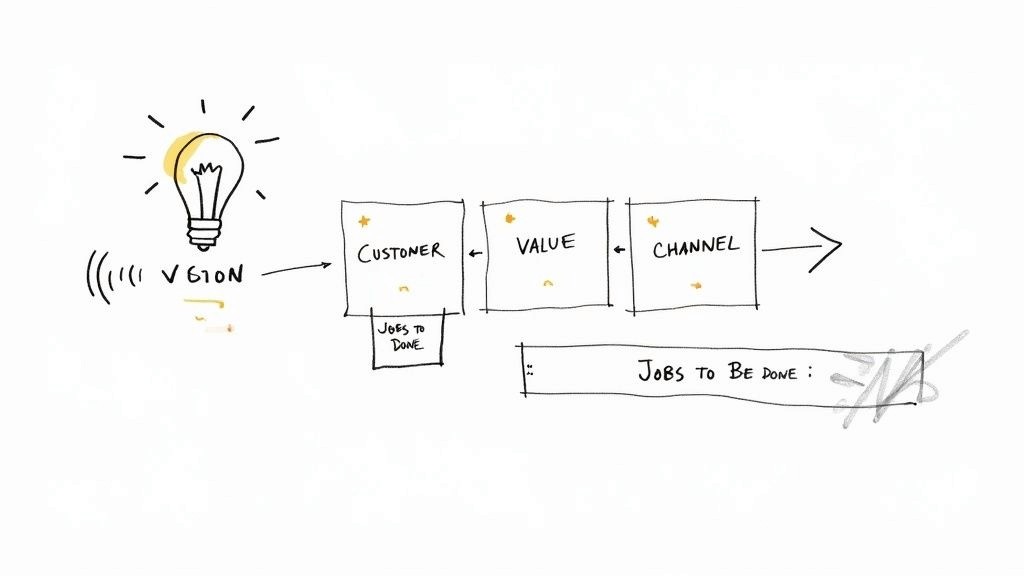
Before crafting your value proposition, deeply understand your customer's context. The "Jobs to Be Done" framework helps shift the focus from demographics to motivations. Customers don't buy products; they use them to solve specific problems.
For instance, a sales VP isn't just buying CRM software; she needs it to save time on data entry, allowing her team to focus on revenue-generating activities. Understanding this real need reveals the true competitive landscape, which might not just include other CRM solutions but also manual processes currently being used.
Breaking Down Your Business Model
With the customer's "job" defined, dissect your business model into critical assumptions:
Problem-Solution Fit: Does your solution effectively address a significant problem?
Product-Market Fit: Is there a segment willing to pay for your solution?
Go-to-Market Fit: Can you acquire customers profitably?
Translate these into measurable hypotheses. Avoid vague assertions like "Users will love our product." Be precise and set clear success criteria.
Practical Experiments to Validate Demand
Once you've conducted interviews and confirmed the problem, it’s time to test the solution. The goal is to design affordable experiments that provide solid evidence of demand.
Don't rush to build a polished product. Start with lean, high-learning experiments. You're not building a product yet; you're building a mechanism to generate evidence.
Tests and Landing Pages
A trial test gauges initial interest. Create a landing page with a clear value proposition and call-to-action, like "Join the Beta." Drive traffic to the page and measure conversion.
Target: Measure market interest before developing anything.
Metrics: A 5-10% conversion rate from targeted traffic is a positive signal.
Tools: Use platforms like Webflow or Framer to create a professional page quickly.
If prospects aren't willing to provide an email, they likely won't pay later.
Manual Service MVP and Illusion MVP
With a Manual Service MVP, provide the value directly to your first customers through hands-on efforts. For example, if your idea is an AI service that generates reports, initially create those reports by hand for early clients.
The Illusion MVP involves creating a user-friendly interface while handling the complex processes manually in the background. This allows you to test user interaction with sophisticated solutions without a large technical investment.
These approaches systematically lower risk. By focusing on practical actions, you support the development of your startup, setting the stage for a product that customers are willing to purchase.
Deciding on the Next Steps: Pivot or Persevere
After running experiments, interpret the data to decide whether to pivot or persevere. This decision is crucial and can be clouded by biases. Set clear success criteria before starting any tests to avoid subjective judgments.
Combine quantitative data with qualitative feedback for a complete picture. A low conversion rate is a data point; understanding why people didn't convert is actionable intelligence.
The Art of Pivoting
A pivot isn’t a failure; it’s a response to new insights. The market has spoken, and you're smart enough to listen. A pivot is not a restart; it’s a strategic shift based on what you’ve learned.
FAQ on Startup Idea Validation
How Much Validation Is Enough?
You're nearing sufficient validation when you can predict interview outcomes. Look for three things: a pressing problem, a resonating value proposition, and customer commitment.
Best Tools for AI Startup Validation
Use tools like Webflow for landing pages, and platforms like Bubble for interactive demos. Dovetail helps organize feedback into insights. For AI, a Wizard of Oz MVP simulates your solution before building the tech.
Handling Negative Feedback
Negative feedback is valuable. Don't get defensive. Use clarifying questions to understand objections. Look for patterns in feedback to determine if the problem or solution needs adjustment.
Conclusion
Ready to move from a validated idea to a market-ready product? Magic specializes in fast, high-quality AI MVP development. We turn your vision into a functional application, leveraging our expertise and no-code platforms for a quick turnaround. Explore our AI startup services to build your MVP with us.